
Class 9 Mathematics Ganita Manjari Part 1 NCERT Solutions
Chapter-8: Predicting What Comes Next: Exploring Sequences and Progressions
Exercise Set 8.3
1. Find the 12^{th} term of a GP with common ratio 2, whose 8th term is 192.
Solution:
Common ratio, r=2
8^{th} term: a_8=192
n^{th} term of a GP:
a_n=ar^{n-1}
Put n=8 and r=2
a_8=a×2^{8-1}
192=a×2^7
a=\frac{192}{2^7}
12^{th} term:
a_{12}=\frac{192}{2^7}×2^{12-1}
a_{12}=\frac{192}{2^7}×2^{11}
a_{12}=192×\frac{2^{11}}{2^7}
a_{12}=192×2^{(11-7)}
a_{12}=192×2^4
a_{12}=192×16
a_{12}=3072
2. Find the 10^{th} and n^{th} terms of the GP: 5, 25, 125, … .
Solution:
Given GP: 5, 25, 125, …
First term, a=5
Common ratio, r=\frac{25}{5}=5
n^{th} term:
a_n=ar^{n-1}
Put a=5, r=5
a_n=5×5^{n-1}
a_n=5^{(1+n-1)}
a_n=5^n
a_{10} term:
a_{10}=5^{10}
a_{10}=9,765,625
*3. A sequence is given by the recursive rule t_1=2, t_{n+1}=3t_n-2 for n \ge 1. Which term of the sequence is 730?
Solution:
t_1=2, t_{n+1}=3t_n-2
Put t=1
t_2=3t_1-2
t_2=3×2-2
t_2=6-2
t_2=4
Put t=2
t_3=3t_2-2
t_3=3×4-2
t_3=12-2
t_3=10
Put t=3
t_4=3t_3-2
t_4=3×10⁻²
t_4=30-2
t_4=28
Put t=4
t_5=3t_4-2
t_5=3×28-2
t_5=84-2
t_5=82
Put t=5
t_6=3t_5-2
t_6=3×82-2
t_6=246-2
t_6=244
Put t=6
t_7=3t_6-2
t_7=3×244-2
t_7=732-2
t_7=730
Therefore, 730 is the 7^{th} term of given sequence.
4. Which term of the GP: 2, 6, 18, … is 4374? Write the explicit formula as well as the recursive formula for the n^{th} term.
Solution:
Given GP: 2, 6, 18, …
Here, a=2
r=\frac{6}{2}=3
let a_n=4374
n^{th} term of GP:
a_n=ar^{n-1}
4374=2×3^{n-1}
\frac{4374}{2}=3^{n-1}
2187=3^{n-1}
3^7=3^{n-1} [writing 2187 as power of 3 by prime factorisation]
7=n-1 [comparing exponents]
7+1=n
n=8
Therefore, 4374 is the 8^{th} term of given GP
Explicit formula:
a_n= 2×3^{n-1}
Recursive formula:
a_1=2, a_n=3a_{n-1}, n \ge 2
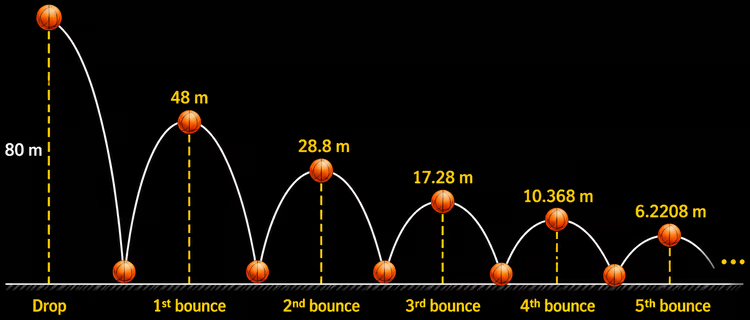
5. A ball is dropped from a height of 80 metres. After hitting the ground, it bounces back to 60% of the height from which it fell. It continues bouncing in this way — each time rising to 60% of the previous height.
(i) What height does the ball reach after the 5^{th} bounce?
(ii) What is the total vertical distance the ball has travelled by the time it hits the ground for the 6^{th} time?
Solution:
Initial drop height=80m
Bounce ratio, r= 60%=0.6
(i) Initial height =80m
Height after 1st bounce =80×0.6=48m
Height after 2nd bounce =48×0.6=28.8m
Height after 3rd bounce =28.8×0.6=17.28m
Height after 4th bounce =17.28×0.6=10.368m
Height after 5th bounce =10.368×0.6=6.2208m
∴ The ball reaches 6.2208 m after 5^{th} bounce.
(ii) Required distance = Initial distance + 2(sum of heights after 1st bounce to 5th bounce)
=80+2×(48+28.8+17.28+10.368+6.2208)
=80+2×(110.6688)
=80+221.3376
=301.3376m
6. Which term of the sequence 2, 2\sqrt{2}, 4, … is 128?
Solution:
Given sequence: 2, 2\sqrt{2}, 4, …
\frac{a_2}{a_1}=\frac{2\sqrt{2}}{2}=\sqrt{2}
\frac{a_3}{a_2}=\frac{4}{2\sqrt{2}}=\sqrt{2}
So it is a GP with:
a=2, r=\sqrt{2}
n^{th} term:
a_n=ar^{n-1}
let a_n=128
2×(\sqrt{2})^{n-1}=128
(\sqrt{2})^{n-1}=\frac{128}{2}
(\sqrt{2})^{n-1}=64
(2^{1/2})^{n-1}=2^6
2^{\frac{n-1}{2}}=2^6
\frac{n-1}{2}=6
n-1=6×2
n=12+1
n=13
Therefore, 128 is the 13^{th} term of the given sequence.
7. Fig. 8.12 shows Stages 0 to 3 of the Sierpiński square carpet. Stage 0 of this fractal is a square sheet of paper. To construct Stage 1, each side of the square is trisected and the points of trisection of opposite sides are joined to obtain nine smaller squares. The centre square is then removed and the 8 smaller squares are retained, leaving a square hole in the centre. The same process is repeated on the eight smaller shaded squares to obtain Stage 2 and so on.

Look at Fig. 8.12 and try to answer the following questions.
(i) How many red squares are there in Stages 0 to 3?
Solution:
Stage 0
There is only the original red square: 1
Stage 1
The original square is divided into 9 smaller squares.
The centre one is removed, leaving: 9-1=8
So, Stage 1 has: 8 red squares.
Stage 2
The same process is repeated on each of the 8 red squares.
Each red square produces 8 smaller red squares: 8×8=64
So Stage 2 has: 64 red squares.
Stage 3
Again, each of the 64 red squares produces 8 smaller red squares: 64×8=512
So Stage 3 has: 512 red squares.
∴ The numbers of red squares in Stages 0 to 3 are: 1,8,64,512
(ii) Can you predict the number of red squares in Stages 4 and 5?
Solution:
We can see that every stage has 8 times as many red squares as the previous stage.
Stage 4
512×8=4096
Stage 5
4096×8=32768
(iii) Can you find a rule for the number of red squares at the nth stage? Write the explicit formula as well as the recursive formula for the number of red squares at any stage.
Solution:
The sequence is: 1,8,64,512,….
Explicit formula: a_n=8^n
Recursive formula:
a_0=1, a_n=8×a_{n-1}, n \ge 1
(iv) Suppose the area of the square in Stage 0 is 1 square unit. What is the area of the red region in Stages 1, 2 and 3? What will be the area of the red region in Stages 4 and 5? Find the explicit as well as the recursive formula for the area of the red region at the n_{th}] stage. What happens to this area as n, the number of stages, goes on increasing?
Solution:
The area of the square in Stage 0 is 1 square unit.
At every stage, each red square is divided into 9 equal squares, and the middle square is removed.
Therefore, the fraction of the area that remains red is: \frac{8}{9}
So the area is multiplied by \frac{8}{9} at every stage.
Area of square at stage 1 =1×\frac{8}{9}=\frac{8}{9} sq unit
Area of square at stage 2 =\frac{8}{9}×\frac{8}{9}=(\frac{8}{9})^2 sq unit
Area of square at stage 3 =(\frac{8}{9})^3 sq unit
Area of square at stage 4 =(\frac{8}{9})^4 sq unit
Area of square at stage 5 =(\frac{8}{9})^5 sq unit
Explicit forma for area:
A_n=(\frac{8}{9})^n
Recursive formula for area:
A_0=1, \frac{8}{9}×A_{n-1}, n \ge 1
What happens to the area as n increases?
Since, 0<\frac{8}{9}<1
Raising \frac{8}{9} to larger powers makes the value smaller and smaller.
Hence, the area of the red region approaches 0 as the number of stages increases