
Class 9 Mathematics Ganita Manjari Part 2 NCERT Solutions
Chapter 9: Propositions and their Converses
Excercise Set 9.1
Frame the converse for each of the propositions in Questions 1–12. Then, determine if each of the two statements is true or not. Justify the true statements and give a counter example for each false statement.
1. If two lines are parallel, then the corresponding angles formed by a transversal are equal.
Solution:
Proposition P: If two lines are parallel, then the corresponding angles formed by a transversal are equal.
Converse Q: If the corresponding angles formed by a transversal are equal, then the two lines are parallel.
Proposition P is True.
Justification: This is the Corresponding Angles theorem in Euclidean geometry.
Converse Q is True.
Justification: This is the converse of the Corresponding Angles theorem, which is a standard criterion used to prove lines are parallel.
2. If a quadrilateral is a square, then all its angles are equal.
Solution:
Proposition P: If a quadrilateral is a square, then all its angles are equal.
Converse Q: If all angles of a quadrilateral are equal, then it is a square.
Proposition P is True.
Justification: A square is a regular quadrilateral, meaning it’s all four sides are equal and all four angles are equal (90° each).
Converse Q is false.
Counter example: A rectangle with side lengths 3 cm and 5 cm has four equal angles (90° each), but its all sides are not equal, so it is not a square.
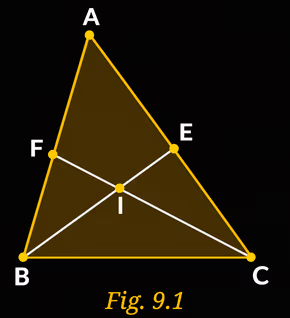
*3. Given any ∆ABC, let us bisect the angles at B and C. The bisectors meet at the incentre I of the triangle. Now extend the bisectors beyond I till they meet the opposite sides at E and F respectively, as shown.
Proposition: If AB = AC, then IE = IF.
Solution:
Proposition P: If AB = AC, then IE = IF.
Converse Q: If IE = IF, then AB = AC
Proposition P is True.
Justification:
If AB = AC
Then ΔABC is an isosceles triangle.
∴ ∠B = ∠C [angles opposite to equal sides of a triangle are equal]
BE and CF are the angle bisectors of ∠B and ∠C.
∴\dfrac{1}{2}\angle B=\dfrac{1}{2}\angle C …. (1)
In ΔIBC
∠IBC = ∠ICB [from (1)]
⇒ IB = IC …. (2) [angles opposite to equal sides of a triangle are equal]
Compare ΔIBF and ΔICE
∠IBF = ∠ICE [from (1)]
IB = IC [from (2)]
∠FIB = ∠EIC [vertically opposite angles]
∴ by ASA congruency rule
\Delta IBF \cong \Delta ICE
∴ IE = IF [by CPCT]
Converse Q is False.
Counter Example:
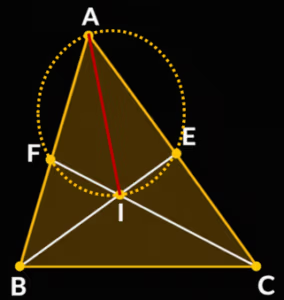
Construct \Delta ABC with angle measures:
\angle A = 60^\circ \quad \angle B = 80^\circ \quad \angle C = 40^\circ
Check AB = AC:
Since \angle B \neq \angle C, therefore the opposite sides are not equal (AB \neq AC).
Check AB = AC:
\angle B + \angle C = 80^\circ + 40^\circ = 120^\circ
Since BI and CI bisect \angle B and \angle C:
\angle IBC + \angle ICB = \frac{\angle B}{2} + \frac{\angle C}{2} = \frac{\angle B + \angle C}{2} = \frac{120^\circ}{2} = 60^\circ
In \Delta IBC:
\angle BIC = 180^\circ – (\angle IBC + \angle ICB) = 180^\circ – 60^\circ = 120^\circ
\angle EIF = \angle BIC [vertically opposite angles]
∴ \angle EIF = 120^\circ
Now \angle A + \angle EIF = 60^\circ + 120^\circ = 180^\circ
Since if sum of a pair of opposite angles is 180^\circ, then quadrilateral AEIF is a cyclic quadrilateral
Now, Draw the circumcircle passing through points A, E, I, F.
And the line segment AI is the angle bisector of \angle A, so:
\angle FAI = \angle EAI = 30^\circ
We know that, in any circle, equal inscribed angles subtend equal chords:
•The inscribed angle \angle FAI subtends the chord IF.
•The inscribed angle \angle EAI subtends the chord IE.
Since \angle FAI = \angle EAI, their corresponding chords must be equal:
IE = IF
Since IE=IF is true while AB\neq AC, the converse Q is False.
4. If x=y, then a+x=a+y, where x,\ y and a are any three numbers. This proposition and its converse are routinely used while solving equations.
Solution:
Proposition P: If x=y, then a+x=a+y
Converse Q: If a+x=a+y, then x=y
Proposition P is true.
Justification: Adding the same number a to both sides of an equation keeps the both sides equal (Addition property of Equality).
Converse Q is true.
Justification: subtracting a from both sides of a+x=a+y yields x=y (Subtraction property of Equality).
5. If a and b are perfect squares, then ab is a perfect square.
Solution:
Proposition P: If a and b are perfect squares, then ab is a perfect square.
Converse Q: If ab is a perfect square, then a and b are perfect squares.
Proposition P is true.
Justification: Let a=m^2 and b=n^2, where m and n are integers.
Then, ab=m^2⋅n^2
ab=(mn)^2
∴ ab is a perfect square.
Converse Q is false.
Counter example: Let a=2 and b=8. Neither 2 nor 8 is a perfect Square, but their product ab=2×8=16=4^2 is a perfect square.
In Questions 6 and 7, \bm{x} and \bm{y} are real numbers.
6. If \bm{x=y}, then \bm{x^2=y^2}.
Solution:
Proposition P: If x=y, then x^2=y^2.
Converse Q: If x^2=y^2, then x=y.
Proposition P is true.
Justification: Squaring equal real numbers yields equal values.
Converse Q is false.
Counter example: Let x=3 and y=-3
Then, x^2=3^2=9 and y^2=(-3)^2=9
So x^2=y^2 holds, but x \neq y
7. If \bm{x=y}, then \bm{x^3=y^3}.
Solution:
Proposition P: If x=y, then x^3=y^3.
Converse Q: If x^3=y^3, then x=y.
Proposition P is true.
Justification: Cubing equal real numbers yields equal values.
Converse Q is true.
Justification:
Counter example:
Since x^3=y^3
x^3-y^3=0
(x-y)(x^2+xy+y^2)=0
⇒ x-y=0 or x^2+xy+y^2=0
Since x^2+xy+y^2>0 whenever x,y \neq 0
So it follows that x-y=0 ⇒ x=y
In Questions 8–12, \bm{n} is a positive integer.
8. If \bm{n} is divisible by 24, then it is divisible by both 4 and 6.
Solution:
Proposition P: If n is divisible by 24, then it is divisible by both 4 and 6.
Converse Q: If n is divisible by both 4 and 6, then it is divisible by 24.
Proposition P is true.
Justification:
If n is divisible by 24, then
n=24k for some integer k.
∴ n=(4×6)k=4(6k)=6(4k)
So n is divisible by both 4 and 6.
Converse Q is false.
Counter example: Let n=12. The number 12 is divisible by both 4 and 6, but it is not divisible by 24.
9. If \bm{n} is divisible by 60, then it is divisible by both 5 and 12.
Solution:
Proposition P: If n is divisible by 60, then it is divisible by both 5 and 12.
Converse Q: If n is divisible by both 5 and 12, then it is divisible by 60.
Proposition P is true.
Justification:
If n is divisible by 60, then
n=60k for some integer k.
∴ n=(5×12)k=5(12k)=12(5k)
So n is divisible by both 5 and 12.
Converse Q is true.
Justification: LCM(5,12) = 60
∴ any number divisible by both 5 and 12 must be a multiple of their LCM 60.
10. If \bm{n} is the square of a prime number, then it has exactly 3 factors.
Solution:
Proposition P: If n is the square of a prime number, then it has exactly 3 factors.
Converse Q: If n has exactly 3 factors, then n is the square of a prime number.
Proposition P is true.
Justification: If n=p^2 where p is a prime number, its factors are 1, \ p, and p^2, which are exactly 3 distinct factors.
Converse Q is true.
Justification: A number with exactly 3 factors must be of the form p^2, where p is a prime number.
11. If \bm{n} is a product of two unequal prime numbers, then it has exactly 4 divisors.
Solution:
Proposition P: If n is a product of two unequal prime numbers, then it has exactly 4 divisors.
Converse Q: If n has exactly 4 divisors, then n is a product of two unequal prime numbers.
Proposition P is true.
Justification: If n=p⋅q where p and q are distinct primes, its divisor are 1, \ p, \ q, and pq (4 distinct divisors).
Converse Q is false.
Counter example: If n=8=2^3.
The divisors of 8 are 1, 2, 4, and 8 (exactly 4 divisors), but 8 is the cube of a single prime(2^3), not the product of two unequal prime numbers.
12. If \bm{n} and \bm{n+3} have no factors in common, then \bm{n} is not a multiple of 3.
Solution:
Proposition P: If n and n+3 have no factors in common, then n is not a multiple of 3.
Converse Q: If n is not a multiple of 3, then n and n+3 have no factors in common.
Proposition P is true.
Justification: If n is a multiple of 3, then n+3 is also a multiple of 3. Thus, they have 3 as a common factor. Hence, if they have no common factor, n cannot be a multiple of 3.
Converse Q is true.
Justification: Suppose n is not a multiple of 3.
Any common factor of n and n+3 must also divide their difference:
(n+3)-3=3
Therefore, any common factor can only be a factor of 3.
The factors of 3 are: 1, 3
Sincen is not a multiple of 3, So 3 cannot be a common factor.
Therefore, the only common factor is: 1
Hence, nand n+3 have no common factor other than 1.
13. There are no known ‘neat’ expressions that generate only primes! Find counterexamples to the following claims.
(i) All numbers of the form 4n^2+1 are prime.
Solution:
For n=4
4n^2+1=4(4)^2+1
=4(16)+1
=64+1
=65
65 is a composite (65=5×13)
∴ the claim is false.
So, n=4 gives counterexample.
(ii) All numbers of the form n^2+n+11 are prime.
Solution:
For n=10
n^2+n+11=10^2+10+11
=100+21
=121
121 is a composite (121=11×11)
∴ the claim is false.
So, n=10 gives counterexample.
(iii) All numbers of the form 4^n+3 are prime.
Solution:
For n=4
4^n+3=4^4+3
=256+3
=259
259 is a composite (259=7×37)
∴ the claim is false.
So, n=4 gives counterexample.
14. Find counterexamples to the following statements.
(i) If n is a prime number, then 2^n-1 is a prime number.
Solution:
For n=11, which is prime
2^n-1=2^{11}-1
=2048-1
=2047
2047 is a composite (2047=23×89)
∴ the claim is false.
So, n=11 gives counterexample.
(ii) If n is an even number, then 2^n+1 is a prime number.
Solution:
For n=6, which is even
2^n+1=2^6+1
=64+1
=65
65 is a composite (65=5×13)
∴ the claim is false.
So, n=6 gives counterexample.
15. Consider the statement: ‘If a number is divisible by 8, then it is divisible by both 2 and 4’.
(i) Justify the statement.
Solution:
Let a number n is divisible by 8.
So, n=8k for some integer k.
n=2(4k)=4(2k)
∴ n is divisible by both 2 and 4.
Hence, if a number is divisible by 8, then it is divisible by both 2 and 4.
(ii) Recall the divisibility shortcuts that we have studied for different numbers. To check whether a given number is divisible by 8, is it enough to check whether it is divisible by 2 and 4? Why or why not?
Solution:
No, it is not enough
Consider the number 12
12÷2=6 and 12÷4=3
12 is divisible by both 2 and 4
But 12÷8=1.5
Thus 12 is not divisible by 8.
So, divisibility by 2 and 4 does not guarantee divisibility by 8. We must check divisibility by 8 separately.
16. Recall that a shortcut to check whether a given number is divisible by 3 is to add the digits of the number and check if the sum is a multiple of 3. Express the relationship between ‘a number is divisible by 3’ and ‘sum of the digits is a multiple of 3’ using ‘If-then’ sentences.
Solution:
Proposition: If a number is divisible by 3, then the sum of its digits is a multiple of 3.
Converse: If the sum of the digits of a number is a multiple of 3, then the number is divisible by 3.
17. We have identified different types of quadrilaterals — squares, rectangles, parallelograms, rhombi, kites and trapezia. One can identify more types (e.g., we could create a category of quadrilaterals that have equal-length opposite sides).
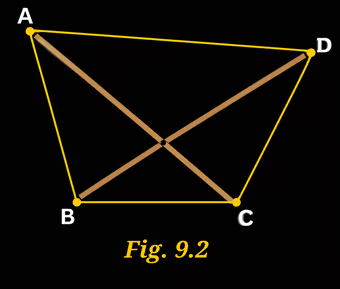
Suppose we have identified a category of quadrilaterals called Q, and we have to construct a quadrilateral of this type. For this, we are to use two thin sticks, put them together as diagonals so that the quadrilateral obtained by joining their endpoints is of type Q (see the Fig. 9.2).
(i) Suppose Q satisfies the following property. If a quadrilateral is of type Q, then it has equal-length diagonals.
(a) Should the two sticks be of equal length? Why or why not?
(b) Will it matter how the two sticks are put together?
(ii) Instead of the property mentioned above, suppose Q satisfies the following property.
If a quadrilateral has equal diagonals, then it is of type Q. What will be your answers to (a) and (b) now?
Solution:
(i) Proposition: If a quadrilateral is of type Q, then it has equal-length diagonals.
(a) Yes, the two sticks should be of equal length because every quadrilateral of type Q has equal length diagonals.
(b) No, it will not matter how the two sticks are put together, provided their lengths are equal. Every resulting quadrilateral will have equal-length diagonals and therefore satisfy the given property of type Q.
(ii) Converse: If a quadrilateral has equal diagonals, then it is of type Q.
(a) Yes, the two sticks should be of equal length because the new property requires a quadrilateral of Q to have equal-length diagonals.
(b) No, it will not matter how the two sticks are put together, provided the form a proper quadrilateral. The resulting quadrilateral will have equal-length diagonals, and therefore it will be of type Q.